By Grant Hellermann (SJU ’26) and Abigail Bufkin (CSB ’27)
Please note that this blog post contains images and language that may be disturbing.
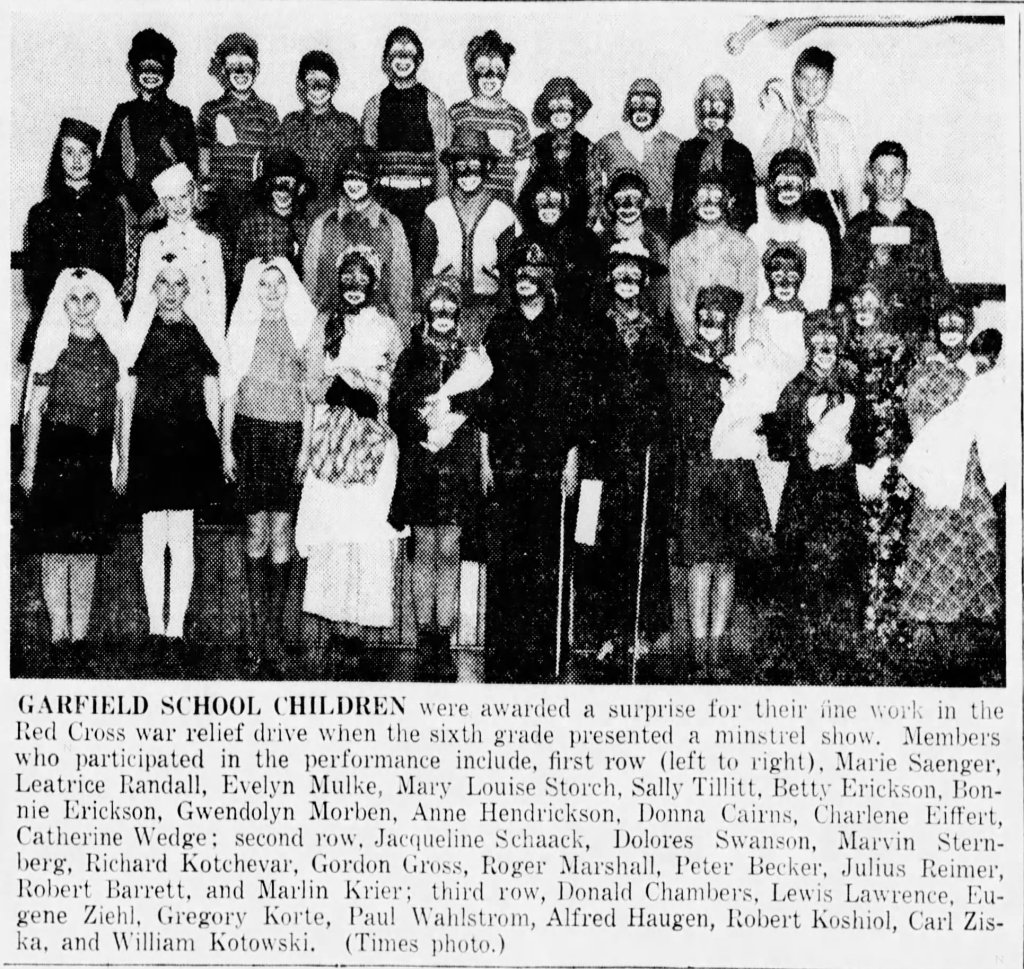
“Garfield School Children,” St. Cloud Times, February 5, 1942, p. 3
Introduction
Minstrel shows have been popular in the United States, including Central Minnesota, since the 1800’s, and throughout time these shows have provided people a source of entertainment, fundraising, and created a strong sense of community, while mocking and excluding an entire group and culture of people. Even in towns in Central Minnesota, including St. Cloud and Sauk Centre, where the population of black residents was almost zero, minstrel shows were extremely popular. Through archived newspaper articles and clippings, there have been recordings of minstrel shows performed by “professional” minstrel troupes as well as local community members in Central Minnesota from the 1900s up until the early 1960s. In Central Minnesota, minstrel shows were used as a fundraising technique to raise money for local events. These performances were extremely popular and often had very large turnouts.
Participation in minstrel shows was not only socially acceptable, but in some cases, expected. Important businessmen, other community members, and school children performed. Over time, these shows transitioned from being performed in more formal settings to more community settings. Minstrel shows slowly declined, but we do not know if this was due to an increased awareness of the harm of minstrel shows, or if the increase in new forms of entertainment had an impact. During the same time that minstrel shows were used to bring people together, Black Americans and other people of color were excluded from these communities through racial covenants, which are clauses in housing deeds preventing people of certain races from living on or owning a certain property. Minstrel shows represent further exclusion that people of color, specifically African Americans, faced as they mocked these people and culture. Minstrel shows were another form of exclusion, like racial covenants, emphasizing the idea that African Americans were not welcome in these areas.
Research Process
For our research we searched archives of the Sauk Centre Herald and the St. Cloud Times, two main newspapers from Central Minnesota. We also used sources on the topic of blackface minstrelsy to establish a base understanding of the topic and to help explain social implications of performances found in the newspaper articles. These secondary sources are listed in the “Further Reading” section at the end of this post. Our research spans the years 1900-1969 with a specific focus on 1920-1959.
Change Over Time
In the early 1900s-1920s, minstrel shows were performed by larger, traveling minstrel groups. These performances were put on in official Theatres such as the Caughren Theatre, Grand Opera House, and United Theatre.1 These shows were typically performed by “professionals” who traveled around Minnesota to perform minstrel shows. While instances of local community members performing minstrel shows can be seen throughout these two decades, the majority of shows were put on by traveling minstrel groups in official theatres. These professional minstrel shows significantly changed in the 1930s as more community members performed these shows. In the 1930s and 1950s, minstrel shows took place in community settings such as high schools, middle schools, community centers, veteran hospitals, and local churches. These shows were also performed by community members as girl scouts, high school students, and important businessmen often auditioned and performed roles in these shows. The transition from “professional” minstrel groups performing in official theatres to community members performing at community events highlights the growing availability of minstrel shows. Minstrel shows became more accessible as one could both attend or perform in a show through local community centers or high schools. In the 1950s there is mention of a traveling group, the “Black Faced Minstrels” performing in St. Cloud, but overall, the majority of these shows were put on by community members.2 By the 1960s, minstrel shows in Stearns County seemed to mostly end, but there are increasing advertisements for minstrel radio shows which could potentially be a reason for the sudden decrease in minstrel show popularity.
Fundraising
Minstrel shows in Stearns County were primarily used for two reasons in the twentieth century: entertainment and fundraising. Minstrel shows were first recorded being used as a fundraising technique in the local Sauk Centre’s Junior High Auditorium in 1916, and this trend of minstrel shows being used for fundraising in Stearns Country continued into the early 1950s. Minstrel shows were used for funding different “Shrine” clubs,” men’s clubs, and community centers throughout Central Minnesota. Minstrel shows were also performed to fundraise at local high schools as well as for Girl Scout and Eagle Scout groups.3 Money from these shows were used to buy chairs for community centers, fundraise a high school Junior Ball, finance a football field, and to buy new auditorium curtains for a local high school. A minstrel show was also put on by a Sauk Rapids Lions club in order to purchase glasses for local children.4
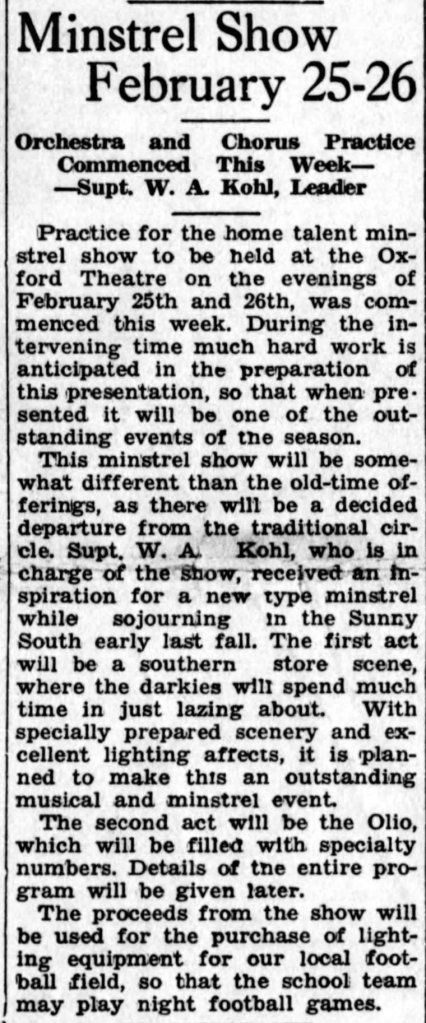
“Minstrel Show Put on Featuring a Southern Store Scene,” Sauk Centre Herald, January 24, 1935, p. 1
These fundraising techniques show how communities benefitted from minstrel shows through both entertainment and fundraising, at the expense of mocking another group and culture.
Advertising
Minstrel show advertisements reveal what society valued in entertainment and give a glimpse into larger social views. From 1920 to 1950, minstrel show advertisements emphasized humor, talent, size of show, and attendance. Humor and talent refer to the content of the show itself, either how much the “audience roared” or how impressive the vocal and acting performances were.5 Both types of accolades were mainly used either when more performances would be offered to drive up ticket sales or, if this were a regular performance (yearly, biannually, etc.) to already begin promotion of the next performance. Advertisements would also mention the number of performers, typically in weeks leading up to the performance. The number of actors or musicians would be noted, such as “Thirty-two blackface men and women,” “40 performers preparing ‘popular ballads’ and ‘old time colored melodies,’” or a show “supported by a blackface chorus of 20 voices.”6 Finally, after a show was performed, reviewers would write in newspapers saying how spectators were “packed like sardines” or even that people were turned away because all the available standing room was taken up.7
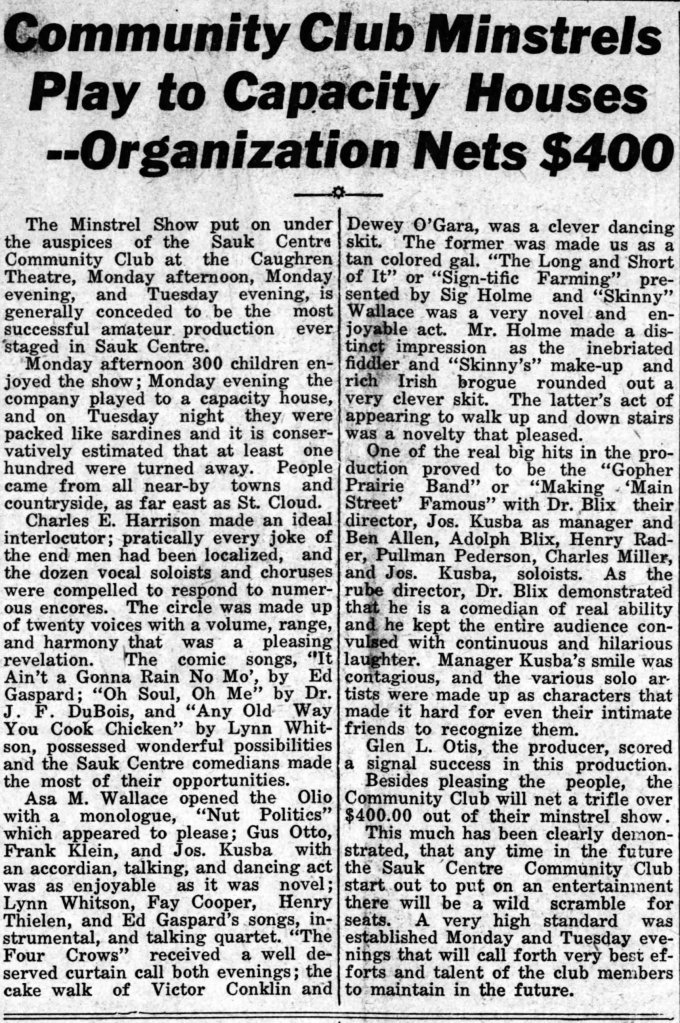
“Community Club Minstrels Play to Capacity Houses–Organization Nets $400,” Sauk Centre Herald, March 6, 1924, p. 1
This eagerness to provide the attendance, number of performers, and such in-depth description of minstrel shows reveals what audiences valued. Central Minnesota communities cared about attendance or a review proclaiming how good a show was since others cared. Because advertisements made a point to include this information, members of the community knew they would enjoy a blackface minstrel performance with its typical humor and song. Knowing this, the shows advertised in newspapers with all of this information to get people in seats and contribute to the success of shows.
Social Acceptability
Minstrel shows did not just thrive because of their advertising, though. The social acceptability of minstrel shows made them wildly popular in the 1920s and 1950s both as a form of entertainment performed by professional travelling troops or as a fundraising event performed by local talent. In the early 1920s, groups with as many as 50 or 60 performers were seen travelling through central Minnesota and giving performances for the public to be entertained.8 As previously mentioned, minstrel shows as a way to fundraise were also becoming popular. One example, which took place in Sauk Centre, starred local talent including members of the Sauk Centre Boosters Club and the mayor.9 Hypothetically, if a mayor participated in a show that was unacceptable to the public, the political career of the mayor could be in question. Logically, since that was not the case and multiple shows were performed by men including those of high standing, shows with blackface performers were socially acceptable in Central Minnesota. Shows were even advertised as having “nothing questionable in any portion of the program,” adding to the argument that performances with blackface were seen as normal occurrences.10
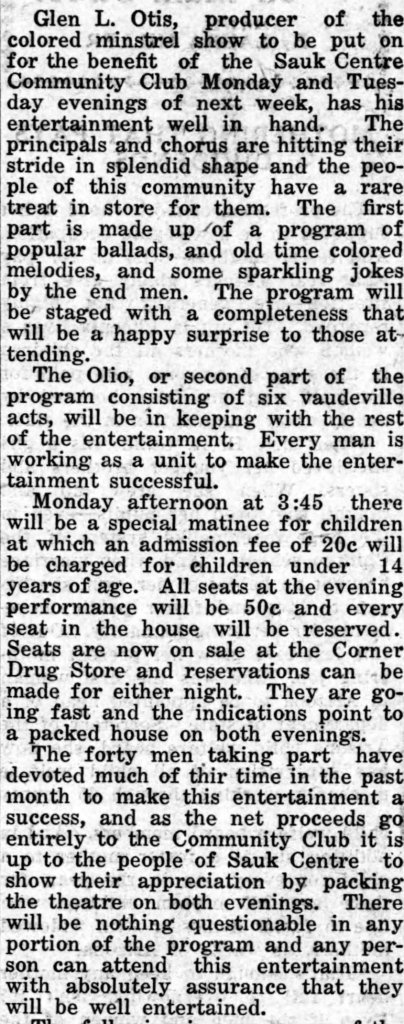
“Community Club Minstrel Show,” Sauk Centre Herald, February 28, 1924, p. 1
These performances were not just acceptable to adult men, though, as entire families would enjoy minstrel shows. Multiple mentions of children attending and enjoying these shows are seen across multiple decades. Some shows in the 1920s had a children’s matinee where kids would get out of school early to be able to attend minstrel shows.11 This expanded in later decades to allow children themselves to participate in the shows with children’s performances put on by schools.12
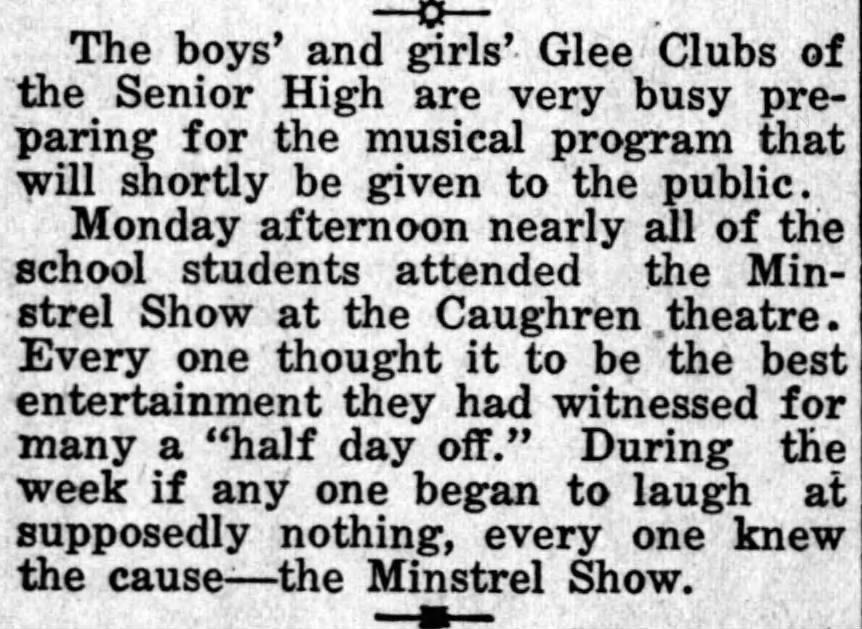
Sauk Centre Herald, March 6, 1924, p. 6
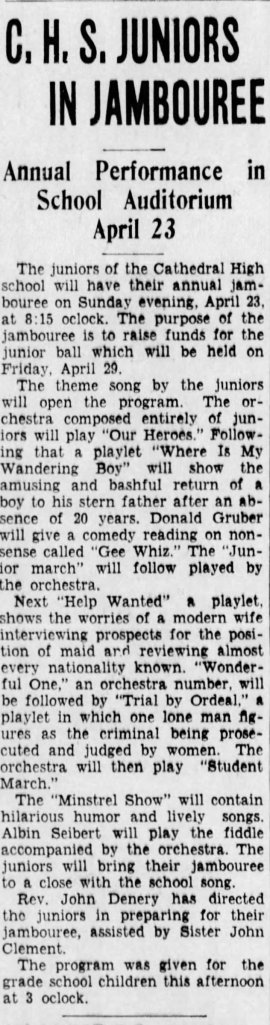
“C.H.S Juniors in Jambouree,” St. Cloud Times, April 21, 1933, p. 4
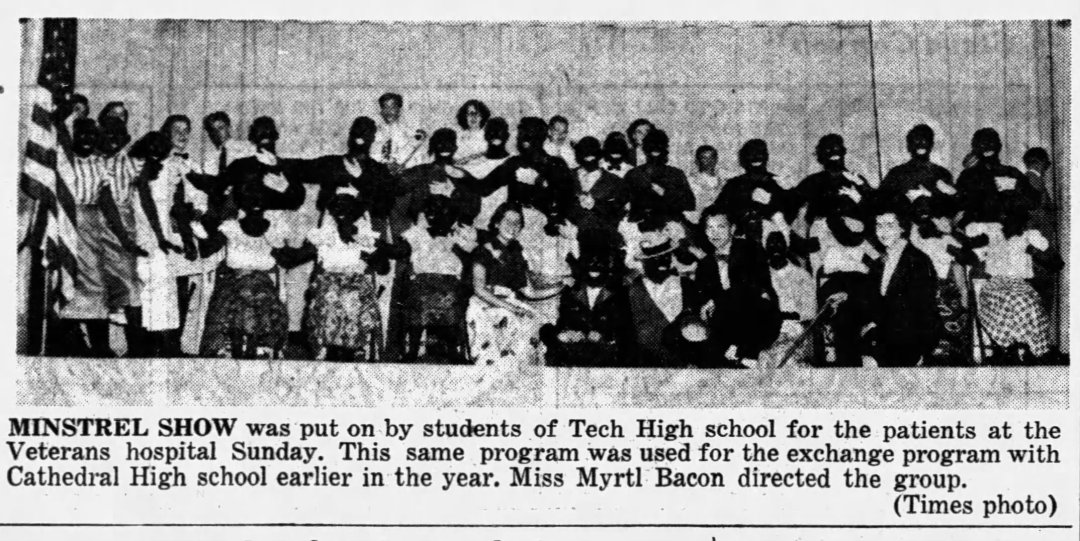
These shows were similar to their adult counterparts with students putting on blackface, singing and dancing, and using similar humor. Both an image of sixth grade students at Garfield performing for a Red Cross fundraiser and a picture of a St. Cloud school group who performed for the Veteran’s Hospital show in 1950 show what performers in a school minstrel show may have looked like.13
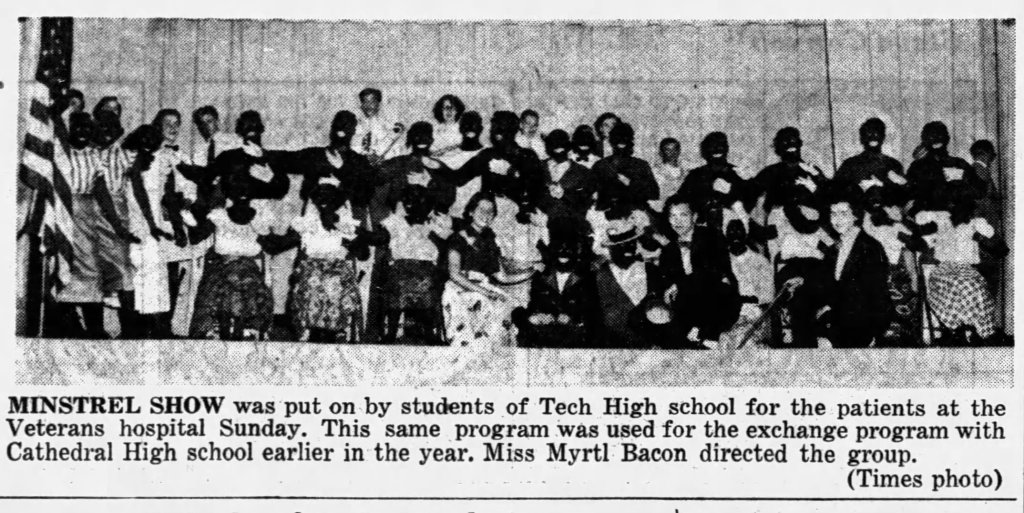
St. Cloud Times, May 15, 1950, p. 17
Some schoolchildren performed minstrel shows as their talent show entries with parents watching and supporting. But children’s exposure to minstrel shows came from outside of schools too, including the Girl Scouts. In 1930, the first mention of Girl Scouts doing minstrel shows was found in our research. This performance was to fundraise for the group, but these performances did not remain simply as a fundraising tool for the scouts, it developed into a badge they could earn. In 1953, a newspaper reported that a Girl Scout troop was performing in blackface to complete requirements for a badge.14
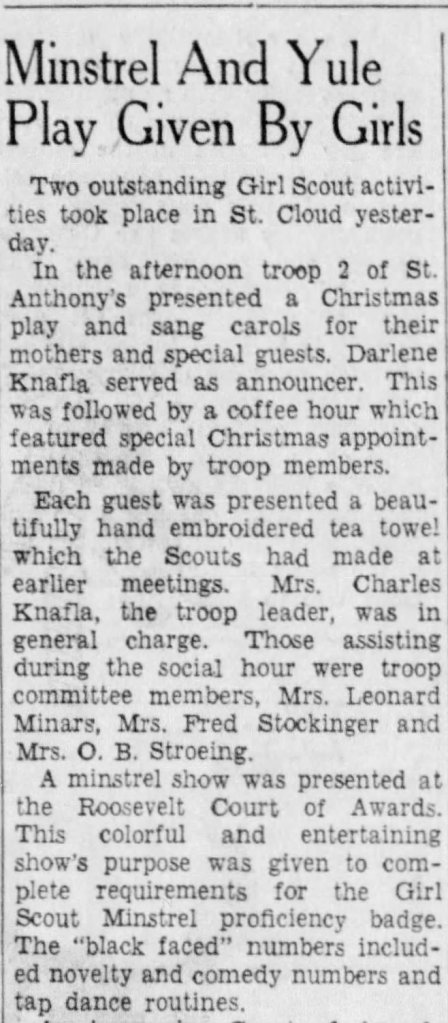
“Minstrel and Yule Play Given by Girls,” St. Cloud Times, December 10, 1953, p. 8
The social acceptability of minstrel shows allowed skilled performance in blackface to be a desired trait is seen by the Girl Scouts creating a badge dedicated to it and by schools allowing and promoting performances. Women also partook in performing minstrel shows to raise money for causes, though these performances were less frequent in our findings.15 So overall, entire family involvement in minstrel shows would not necessarily be out of the question. Children being able to perform such acts at a young age or watching a parent or respected adult perform in blackface show how racist attitudes could be ingrained into children in their early years.
A Way to Connect (and Push Away)
Minstrel shows were a way for communities to come together and share an experience that connected them while at the same time developing shared ideas about “others.” A noteworthy aspect of minstrel shows in our research was that socioeconomic status did not matter regarding performers or attendees. Anyone seemed welcome to participate in the production, with a mayor and “common” men performing side-by-side, and people of any status were able to watch the show as is seen in various reviews posted in newspapers following performances. An event allowing anyone to build camaraderie with people they may not have otherwise interacted with is a powerful way to create a sense of belonging and community. Minstrel shows did just that.
Alongside building camaraderie, the shows also served as instructions on how the audience should view different races, specifically the Black population in America. As American comedian Sid Caesar said, “comedy has to be based on truth.”16 The jokes performed in minstrel shows, the erratic acting styles, and verbal gaffes, were all humorous to the audience because there was a shared belief that, at some lesser level than what was acted, there was truth in it. Admittedly, the adult audience may have known much of what was performed was heavily exaggerated and untrue, but if they didn’t believe even the slightest bit that it reflected how Black Americans acted, support would have died out much faster than history reflects.17
As much as adults may have enjoyed it with the perception that it was not an accurate portrayal, children in attendance may have viewed the performance on stage as more truthful. Minstrel shows involving blackface performers could be perceived as a warning, implying that those in attendance, especially children, should be wary of Black Americans, because they will act in ways very different from their white society. Seeing such portrayals of Black people identifiable as unfamiliar and outcasts, these young people would grow to appreciate their safe white communities much more and defend it against Black people wherever they may be encountered. Hostility towards Black people is seen in an article in the Sauk Centre Herald from 1921 where “colored minstrels” were not widely welcomed and, upon giving two performances, were driven out of the “spotless town.”18 This rhetoric sheds light on the bigger picture. Blackface minstrel shows were a socially acceptable way to rally a community together for camaraderie while simultaneously creating a common antagonist.
Conclusion
While the practice of minstrel shows was nationwide during this time period in America, minstrel shows in Central Minnesota highlight a cultural practice of bringing communities together while excluding certain groups. These minstrel shows were attended by all members of society and brought communities together as well as raised funds for different community events and groups. Well known businessmen, children, everyday citizens, as well as “professional” groups have been recorded putting on these minstrel shows and creating a sense of unity while simultaneously adding to the division of African Americans and other people of color already seen in these areas.
The number of black residents in St. Cloud was limited to single digit numbers from around the 1910s to the 1950s, which led to the stereotypical and mocking minstrel shows becoming the sole source of African American culture citizens were exposed to.19 These minstrel shows, similar to racial covenants, are another example of highlighting the idea that people of color were generally not welcome in Central Minnesota during this time. Minstrel shows were socially acceptable and performed in Central Minnesota from the early 1910s up until the 1960s, which can be seen as a contributing factor to the isolation and marginalization Black Americans might have felt in Central Minnesota. While racial covenants were a legal means to separate African Americans from these areas, minstrel shows were a societal way to emphasize the idea that African Americans were not accepted or welcomed.
Further Reading
This analysis of minstrel shows focusing in central Minnesota and its larger implications is by no means final or extensive. Much further research could be undertaken on facts about minstrel shows in Minnesota or other areas of the nation, social implications at the time, impacts on society today, and many more directions. For further reading on this topic to learn more or begin further research, we recommend:
Lehman, Christopher. “Black Cloud: The Struggles of St. Cloud’s African American Community, 1880-1920.” Minnesota History 66:6 (2019): 234-243.
Roberts, Brian. Blackface Nation Race, Reform, and Identity in American Popular Music, 1812-1925. Chicago The University Of Chicago Press, 2017.
Stephen Burge Johnson. Burnt Cork : Traditions and Legacies of Blackface Minstrelsy. Amherst; Boston: University Of Massachusetts Press, 2012.
Hanif, Abdurraqib, A Little Devil in America: Notes in Praise of Black Performances. First Edition. New York: Random House, 2021.
Yuval, Taylor; Jake, Austen. Darkest America Black Minstrelsy from Slavery to Hip-Hop. W. W. Norton & Company New York London, 2012.
- “Monder Minstrel Show will be at Caughren Theatre, Monday, July 22,” St. Cloud Times, July 18, 1918, p. 3 ↩︎
- “Minstrel Show Set for 3 Days,” St. Cloud Times, February 19, 1952, Pg 4. ↩︎
- “Shriners Club Plans Program,” St. Cloud Times, May 1, 1931, p. 4; “Minstrel Show Will Be Event at Foley,” St. Cloud Times, February 9, 1939, p. 9; “Community Club Minstrels Play to Capacity Houses—Organization Nets $400,” Sauk Centre Herald, March 6, 1924, p. 1; “Sauk Rapids Lions Present Big Minstrel Show Tuesday Evening,” St. Cloud times, January 22, 1931, p. 11; “Girl Scouts Preparing Fine Vaudeville Show,” St. Cloud Times, November 20, 1930, p. 1; “Minstrel Show At Holdingford,” St. Cloud Times, April 29, 1941, p. 9. ↩︎
- “Com. Club Meeting,” Sauk Centre Herald, June 4, 1931, p. 8; “C.H.S Juniors in Jamboree,” St. Cloud Times, April 21, 1933, p. 4; “Committees Named for Minstrel Show,” St. Cloud Times, October 26, 1934, p. 9; “Becker PTA to Give Minstrel Show at High School Tonight,” St. Cloud Times, May 5, 1950, p. 8; “Minstrel Show at Sauk Rapids,” St. Cloud Times, February 17, 1939, p. 3. ↩︎
- “Local Minstrels Please Big Crowds,” Sauk Centre Herald, Apr. 23, 1925, p. 1.; “Home Talent Minstrels Pleased Large Audience,” Sauk Centre Herald, May 19, 1927, p. 1. ↩︎
- “Extravaganza Extraordinary Excellentzium,” The St. Cloud Times, Apr 09, 1920, p. 3; “Community Club Colored Minstrel Show” Sauk Centre Herald,Feb. 28, 1924, pp. 1, 4.; “Royalton Club Will Hold Minstrel Show,” St. Cloud Times, May 02, 1940. p. 3. ↩︎
- “Community Club Minstrels Play to Capacity Houses–Organization Nets $400,” Sauk Centre Herald, Mar. 06, 1924, p. 1; “Famous Georgia Minstrels Under Canvas,” Sauk Centre Herald, Jul. 07, 1910, p. 4. ↩︎
- “Famous Minstrels Will Show at Caughren,” Sauk Centre Herald, Jul. 08, 1920, p. 1. ↩︎
- “Home Talent Minstrels Pleased Large Audience,” Sauk Centre Herald, May 19, 1927, p. 1; “Community Club Minstrels Play to Capacity Houses–Organization Nets $400,” Sauk Centre Herald, Mar. 06, 1924, p. 1; “Community Club Colored Minstrel Show,” Sauk Centre Herald, Feb. 28, 1924, p. 4. ↩︎
- “Community Club Minstrel Show,” Sauk Centre Herald, Feb. 28, 1924, p. 1. ↩︎
- “Children Attend Minstrel Show,” Sauk Centre Herald, Mar. 6, 1924, p. 6. ↩︎
- “C.H.S Juniors in Jambouree,” St. Cloud Times, Apr. 21, 1933, p. 4; “Garfield Stages Red Cross Drive,” St. Cloud Times, Feb. 04, 1942, p. 4; “Fifth Grade at Washington Entertains,” St. Cloud Times, Apr. 20, 1942, p. 6; “Halftime Blackface Minstrel Show,” St. Cloud Times, Dec. 20, 1947, p. 8. ↩︎
- “Garfield School Children,” St. Cloud Times, Feb. 05, 1942, p. 3; “Minstrel Show,” St. Cloud Times, May 15, 1950, p. 17. ↩︎
- “Girl Scouts Preparing Fine Vaudeville Show,” Sauk Centre Herald, Nov. 20, 1930, p. 1; “Minstrel and Yule Play Given by Girls,” St. Cloud Times, Dec. 10, 1953, p. 8. ↩︎
- “Minstrel Show Sponsored by McKinley Mothers,” St. Cloud Times, Apr. 29, 1942, p. 6. ↩︎
- Lisa Respers France, “The Words and Comedy of Sid Caesar,” CNN, February 12, 2014, https://www.cnn.com/2014/02/12/showbiz/celebrity-news-gossip/sid-caesar-comedy. ↩︎
- Yuval, Taylor; Jake, Austen. “Darkest America Black Minstrelsy from Slavery to Hip-Hop,” W. W. Norton & Company New York London, 2012, p. 39. ↩︎
- “Colored Minstrels Co. Were Bum Performers,” Sauk Centre Herald, June 23, 1921, p. 1. ↩︎
- Christopher Lehman, “Black Cloud: The Struggles of St. Cloud’s African American Community, 1880-1920,” Minnesota History 66:6 (2019): 234-243. ↩︎


